

Incantation—New Moon in Scorpio—November 4th.
 All changes, even the most longed for, have their melancholy; for what we leave behind us is a part of ourselves. We must die to one life before we can enter another—Anatole France.
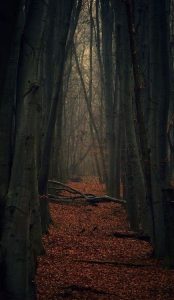
Leaves of copper and gold blanket the black earth, and kelp-scented sea mists bejewel the fragile webs of spiders at this time when the veil between the worlds shimmers, gossamer thin.
This is a liminal time, halfway between the autumn equinox and the winter solstice. A time when we may notice an unsettling shift in the seasons. A time when melancholy wraps itself around the wan light of the dying year and ghoulish costumes create a safe diversion from our squeamishness about death. This is the month when the dead come calling—Día de los Muertos, Day of the Dead. Hallowe’en, loud and gaudy, prickling with single-use plastic, once Allhallowtide, a time in the liturgical year that was dedicated to the departed. Soft-bred pumpkins grimace with menacing faces; bonfires consume summer’s fruitfulness, light-hearted tricks and sugary treats sweeten the older tradition of guising (disguising ourselves from sinister wandering spirits) while ruby-red toffee apples symbolise the potent symbol of the pentagram that lives in secret within every store-bought apple; incantations against the supernatural, rituals for protection against the descent into the dark of the year.
The truth is that the triple faced Cailleach drapes herself in her misty mantle at Samhain. She emerges from rocks of ancient granite and the smooth folds of glistening basalt to run her fingernails across the iron-grey belly of the sky, scraping loose bitter weather. Samhain is the Celtic celebration of summer’s end. A time when the Aos sí emerge from grassy fairy forts to traverse the “thin veil” into the world of humans. At Samhain, we seek to honour the dead who have walked before us. We engage in communal warding off those things that remind us of the fragility of life, the proximity of death.
For those of us who have witnessed the dying process of a cherished pet or a loved one, for those of us who have pared down to the bone after the dismemberment of a divorce, or the devastation of illness that has altered our lives forever know the pain of those irrevocable endings, those radical severances that bring us to our knees, rip off our layers of protection, leave us naked and defenseless. As we stand at the edge of winter, perhaps there is a deep sadness that still lies wetly over our hearts, a remnant of eternal timelines interlaced with others who have lived before us.
For so many of us it is the dying of the earth as we know it that haunts our dreams, intrudes on our walk through the woodlands or on the beach where the corpses of tiny turtles blacken in the sun. As we keep company with the collective grief, we may be brought to tears by an act of kindness, a soft word of sympathy from a stranger—reminders that people are kind, caring. That we are not alone in our sadness. As the invisible threat of the pandemic, the existential crisis of climate crisis continues to strain our limbic system, tire our brains, keep us on high alert, psychologist Emma Kavanagh writes, “this phase we are in now, where everyone feels kind of on the edge, but no one can really articulate why—is what happens when you survive a disaster. When you live through what we have lived through, the net result means being broken by tiny catastrophes.”
 As Nature withdraws, the fading Sun slips into the shade of Scorpio and couples in darkness with the Moon on November 4th, sombre Saturn squares the luminaries, a melancholic reminder of all that has been lost since those first reports of a strange new pathogen emerged from Wuhan. Minimalism, restraint, austerity, checks and balances, will be imperative as hollow men gather in Glasgow to talk, yet again, about the climate crisis. Missing in action will be collaboration and altruism, the solvents that ensure the survival of our species.
It was sixty years ago that Rachel Carson, ill with cancer and in great pain, wrote Silent Spring, a book that was denounced and vilified by the major chemical companies. She said then, “I think we’re challenged as mankind has never been challenged before to prove our maturity and our mastery, not of nature, but of ourselves”.
Re-reading her words, now, two full Saturn cycles later, as we continue to beat nature into submission like little dictators, it is hard to imagine that we will have the maturity to change our behaviours; to comprehend that we are only a small thread in the web of life.
Yet, innovative, radical Uranus makes an opposition to this New Moon and Venus moves into serious Capricorn as Mercury enters Scorpio on November 6th, adding a colourwash of practicality and depth to our human interactions this month.
Pluto and Mars are invoked when we talk about the Scorpion. Mars moves fearlessly into the blackness of Scorpio on October 30th followed by fleet-footed Mercury, and though we talk glibly of transformation, Pluto, still moving through Capricorn and square to Eris, coils around that over-used cliché. When we enter the realm of Scorpio, the mystery of life and death are at work. Snakes shed their skins and feathered phoenixes emerge from scorching flames in a world that is no longer pristine and pure, but is still breathtakingly beautiful even as microplastics and chemicals seep through the earth’s capillaries, and the wild flowers and butterflies we knew when we were young have gone.
Scorpio, in its true essence, asks us to dive deep into waters diffuse and dark; to dredge up what lies beneath: a collective fear that concretises into protocols and incantations that we hope will keep us safe; a collective scarcity that clutches and clings; the fragile vulnerability of the top predator with imposter syndrome who has forgotten the interconnection and interdependence of all living things.
Writes Rachel Carson, “the more clearly we can focus our attention on the wonders and realities of the universe, the less taste we shall have for destruction.”
As the light slips softly off the hillsides, we stand now in the potent darkness of this New Moon. New Moons are generative times. Seeding moments when we plant wishes in the darkness and wait patiently, expectantly, for them to grow. Rachel Carson invites us to consider this: “one way to open your eyes is to ask yourself, “What if I had never seen this before? What if I knew I would never see it again?”
 For astrology readings and more information about forthcoming virtual workshops please email me directly: ingrid@trueheartwork.com

 As brittle leaves blanket the black earth in copper and gold there is something poignantly reassuring in the contracting light of autumn. Yet as Nature responds to the ancient rhythm of life and death, some of us may sense a seam of blackness in a world advancing through a dark night of the soul. As the inevitable juddering, shuddering climax of climate change, habitat loss, micro-plastics and global warming is shrugged off by plutocrats and self-serving politicians, as thousands starve in Yemen, and “rogue killers” prowl through the Saudi Consulate, torture and gruesome death is the price paid for speaking out.
 Venus Rx, Mercury and Jupiter are the Sun’s travelling companions this month. Jupiter’s passage through Scorpio—October 11, 2017—November 8, 2018 has been the Pandora’s Jar from which all kinds of “great and unexpected troubles” have oozed—Jupiter magnifies and amplifies, and in Scorpio, this has been the sexual harassment and assault has exposed the sepsis in our society that has festered in silence, for years. The renewal and trans-formative power of human sexuality, as well as the distorted perversions and abuse of sexuality are Scorpionic themes, trivilaised on TV in the titillating Bisexual and the toe-curlingly awful Wanderlust. Venus has vanished from the sky. She’s dressed in black, withdrawn, reflective. These forty days and forty nights, we may encounter those things that arouse a visceral response. We may recoil from encounters or sensory experiences that sting or poison us. Venus is the arbiter of our values, the tempera on our creative canvas. She’s our detector, altering us to those circumstances, relationships, or more literally, to a sense that our tastes have changed. We not longer crave a certain food, love a certain style of fashion. The art or music that evoked a strong reaction now seems banal. The person we thought we liked or loved with such fervor fails to engage our interest as Venus stirs within us an internal transfiguration.


